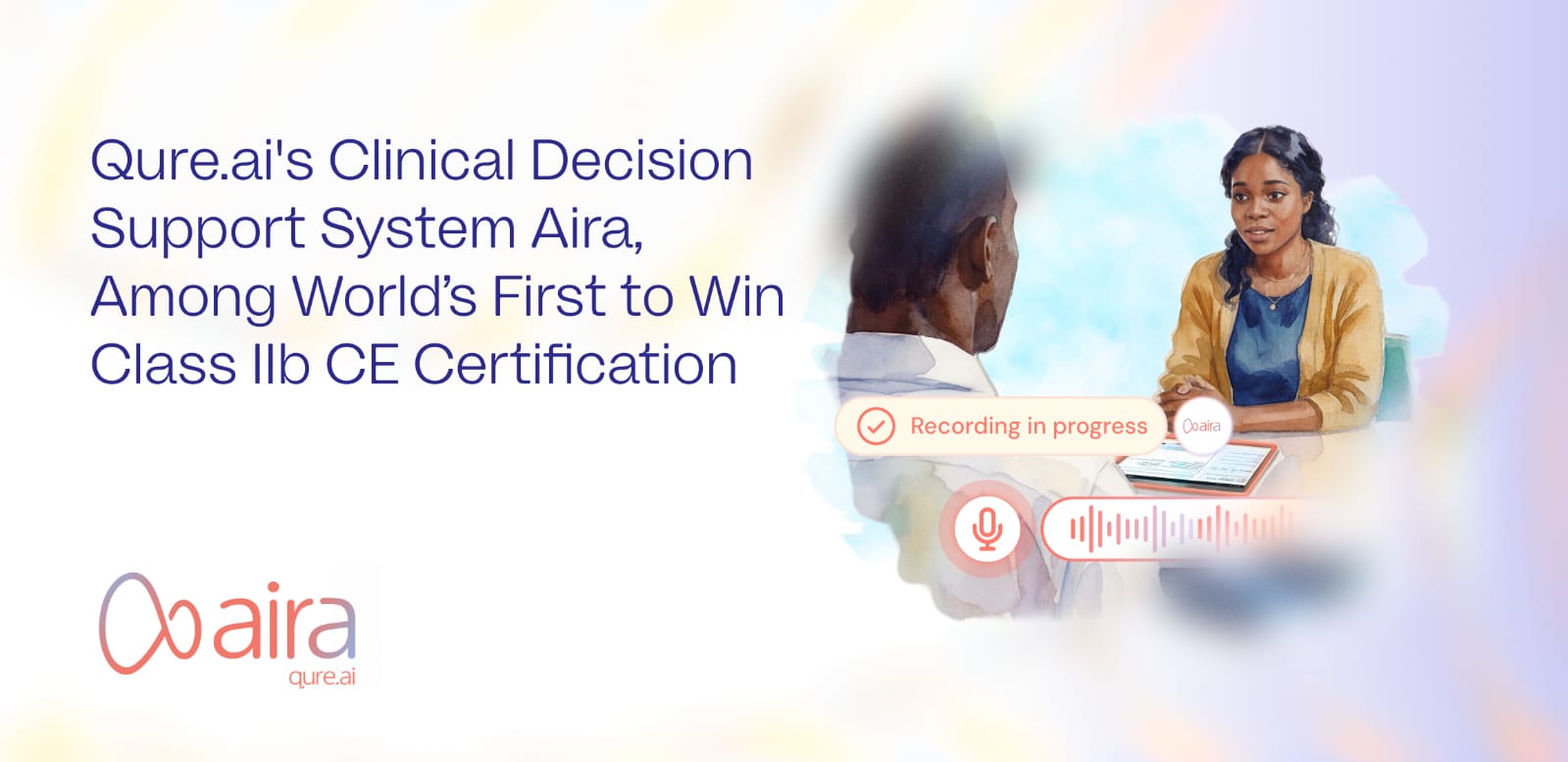
Built for frontline primary care in emerging economies,
Aira is the first AI-powered clinical decision support system (CDSS) to combine
documentation, workflow automation and analysis of patient EHR data with
clinical decision-making under a single CE mark.

Back
Qure.ai, a global
leader in AI-powered early diagnosis and care orchestration, today announced
that Aira has received Class IIb CE certification under the EU Medical Device
Regulation (MDR) for its clinical decision support system (CDSS). This
milestone comes a year after Aira's launch and extends Qure.ai's decade of
experience in regulated medical AI – spanning TB, lung cancer and other
non-communicable diseases – to AI powered clinical decision support.
Launched at the World Health Assembly in 2025, Aira is built
to address three persistent challenges in primary care: workforce shortages,
inconsistent adherence to clinical guidelines, and the administrative burden
that takes health workers away from patients. The platform integrates with
existing health systems as an AI layer on top, turning consultations and paper
records into a digital care trail, equipping health workers with patient
history and national guideline-based recommendations, and maintaining patient
contact between visits. Built for local languages, existing digital devices and
unreliable connectivity, Aira makes digitization part of care delivery rather
than an additional task for overstretched frontline workers.
By automating routine documentation and follow-up, and
delivering current clinical guidance into everyday care, Aira helps stretched
health workers maximize their time to deliver higher quality care. The ambition
is to make consistent, connected primary care possible even where workforce
capacity and digitization remain limited.
"The quality of primary care a person receives
should not be decided by their postcode," said Prashant Warier,
Co-founder and CEO of Qure.ai. "But a health worker cannot give a
patient their full attention while filling registers, searching for guidance
and chasing missed appointments. We built Aira to take on that work. Class IIb
certification is an important milestone because it validates our clinical
decision support within one of the world's most rigorous medical device
regulatory frameworks. The bigger ambition is to put dependable clinical
intelligence within reach of the people delivering care where resources are
stretched furthest."
Under the EU Medical Device Regulation, Class IIb
classification reflects one of the EU's highest levels of regulatory scrutiny
for software supporting decisions where accuracy and reliability are critical
to patient outcomes. Aira's clinical decision support has been certified under
this framework, giving health ministries, providers and funders an
independently assessed foundation for evaluation and procurement, subject to
applicable local rules.
In its first year, Aira has scaled to ten live pilot sites
reaching thousands of patients and care seekers across wide-ranging last-mile
and urban contexts in Nigeria, Kenya, Mozambique, Solomon Islands and
Bangladesh. In Nigeria, it supports ART-center (Anti-Retroviral Therapy) health
workers with structured data capture and guideline-based decision support,
delivered with the Catholic Caritas Foundation of Nigeria in Enugu and Ebonyi,
and the Adamawa State HIV/AIDS and STI Control Program.
In Kenya, Aira is deployed with local implementation
partners and Ministry of Health departments. In Mozambique, it is integrated
into AlôVida, the national platform run by the Ministry of Health (MISAU), with
VillageReach as implementing partner and Qure.ai providing the technology,
supporting pandemic preparedness through a Gates Foundation initiative. In the
Solomon Islands, Aira has digitized paper-based health reporting in support of
WHO's Western Pacific Regional Office national reporting work. In Bangladesh,
it is being deployed with the support of Endless Health.
In a Kenya outreach program, Aira cut time spent on
protocol-driven documentation by 32% while ensuring a 98% completion rate in
documentation tasks. Within primary HIV care facilities in Nigeria, the
clinical-to-administrative time ratio improved by 67% in favor of
patient-facing time, alongside a 23% reduction in administrative time.
Aira also supports continuous patient care between visits.
In Nigeria, automated calls in Hausa and English remind patients about upcoming
appointments and reconnect with patients who have missed scheduled care while
also helping ensure consistent adherence to clinical protocols across teams.
Qure.ai's broader AI portfolio is deployed across 105+
countries, with 26+ FDA-cleared findings and CE marking for 60+ indications.
The company is now working with ministries of health and institutional funders
on population-scale deployments of Aira over existing national systems, with
the aim of building a larger evidence base for AI-supported care and patient
outcomes.
Qure.ai believes this is the beginning of a broader shift:
AI that doesn't just support diagnosis but strengthens the entire primary care
system around it, turning every health worker interaction into an opportunity
for guideline-driven, data-backed care. At population scale, this is how the
global health community closes the primary care gap for the billions still
underserved.
To know more about Aira: https://www.qure.ai/aira
About Qure.ai
Qure.ai is a global AI company innovating
diagnostic solutions in healthcare for early detection and care management.
Qure’s solutions power early diagnosis in lung cancer, neurology and infectious
disease to support clinicians and propel developments in the pharmaceutical and
medical device industries. The company empowers healthcare workers or health
systems by helping to identify conditions fast, prioritize treatment planning
and ultimately improve quality of patient life. Qure.ai has deployments in over
107 countries, with regional offices in New York, London and Mumbai. It is a
TIME100 Most Influential Company 2025.