Looking back on FY 2024–25, what stands out most is not just how far Qure.ai has come, but how many lives this collective effort has been able to touch. The past year reinforced why we do what we do, building technology that strengthens healthcare systems and helps clinicians act earlier, faster, and with greater confidence. At Qure.ai, our purpose continues to guide every decision we make: harnessing artificial intelligence to close gaps in care and bring timely diagnosis within reach, no matter where a patient lives.

Back
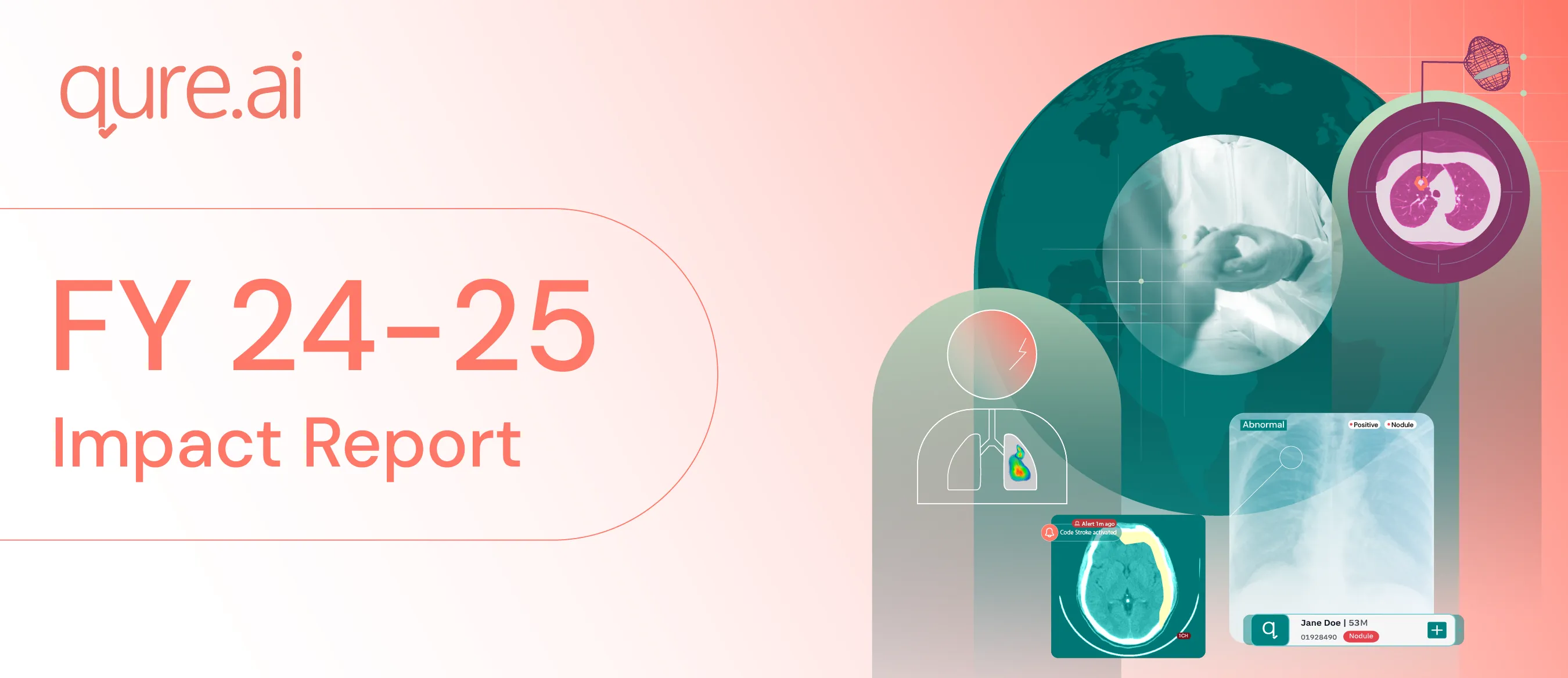
FY 2024–25 marked a defining chapter in that journey. This year, Qure.ai’s AI solutions reached more than 32 million lives, expanding our footprint to over 4,500 healthcare facilities across 100+ countries. Behind every statistic lies a human story, a diagnosis made earlier, a treatment started sooner, a life changed because technology met care at the right moment.
Our impact in global health continued to deepen. qXR screened over 7 million people for tuberculosis in FY 24–25 alone, flagging more than 6,50,000 individuals at risk, many in settings where access to radiologists, internet connectivity, or even stable electricity remains limited. From mobile screening vans in Nigeria and retrofitted X-ray machines in Kenya, Malawi, and liberia our AI-enabled faster diagnosis, reduced costs, and helped bring the “missing millions” into care. Independent evidence reaffirmed this impact, demonstrating higher TB notifications and meaningful cost savings for national health systems.
This year also saw significant advances in lung cancer detection, an area where late diagnosis remains one of healthcare’s most persistent challenges. As health systems worldwide look for scalable ways to identify disease earlier, AI-enabled chest X-rays are emerging as a powerful tool for change. In partnership with AstraZeneca and as part of the EDISON Alliance’s 1 Billion Lives Challenge, we surpassed 5 million people screened for lung cancer across 20 countries. Evidence from the CREATE study proved that routine chest X-rays, when augmented by AI, can become powerful tools for early intervention. From nationwide programs in El Salvador and Malaysia to expanding adoption across the United States, we are helping health systems shift from reactive diagnosis to proactive care.
In Neurocritical care, our AI solutions continued to prove that time truly matters. qER supported the screening of over 5,30,000 patients this year, flagging 65,000 critical findings and enabling faster triage in emergency settings. In Punjab, India, AI-powered hub-and-spoke stroke pathways reduced treatment delays and brought specialist-level care closer to patients, improving outcomes when every second counted.
Beyond scale, FY 24–25 was a year of milestones. We took AI-powered screening to new heights, literally, achieving the world’s highest-altitude chest X-ray screening at Everest Base Camp. We closed a $65 million Series D funding round, strengthening our ability to invest in science, people, and long-term impact. We received new regulatory clearances, published high-impact clinical evidence, and were recognised among TIME’s 100 Most Influential Companies of 2025, reaffirming Qure.ai’s global leadership in responsible, evidence-driven healthcare AI.
Perhaps most importantly, we continued to build for the future. With the launch of Aira, our AI co-pilot for frontline health workers we are moving beyond standalone tools toward integrated digital health ecosystems, designed to support primary care, strengthen national programs, and amplify human capability where it is needed most.
As we step into the next year, we carry a deep sense of responsibility to our partners, to health systems, and most importantly, to the millions of patients who rely on early and accurate diagnosis. None of this progress would be possible without the commitment of our teams and partners, the trust of governments and clinicians, and the shared belief that technology must always serve people.
Thank you for being part of this journey. Together, we are not only advancing artificial intelligence in healthcare, we are redefining access, strengthening systems, and shaping a future where early detection becomes the norm, not the exception.