Early detection of malignant pulmonary nodules remains a significant barrier in lung cancer care, especially in regions where access to low-dose CT (LDCT) is limited. While chest X-rays are widely used and often serve as the first point of imaging, their utility to accurately stratify the malignancy risk of incidental pulmonary nodules (IPNs) is inherently limited.

Published 19 Jan 2026
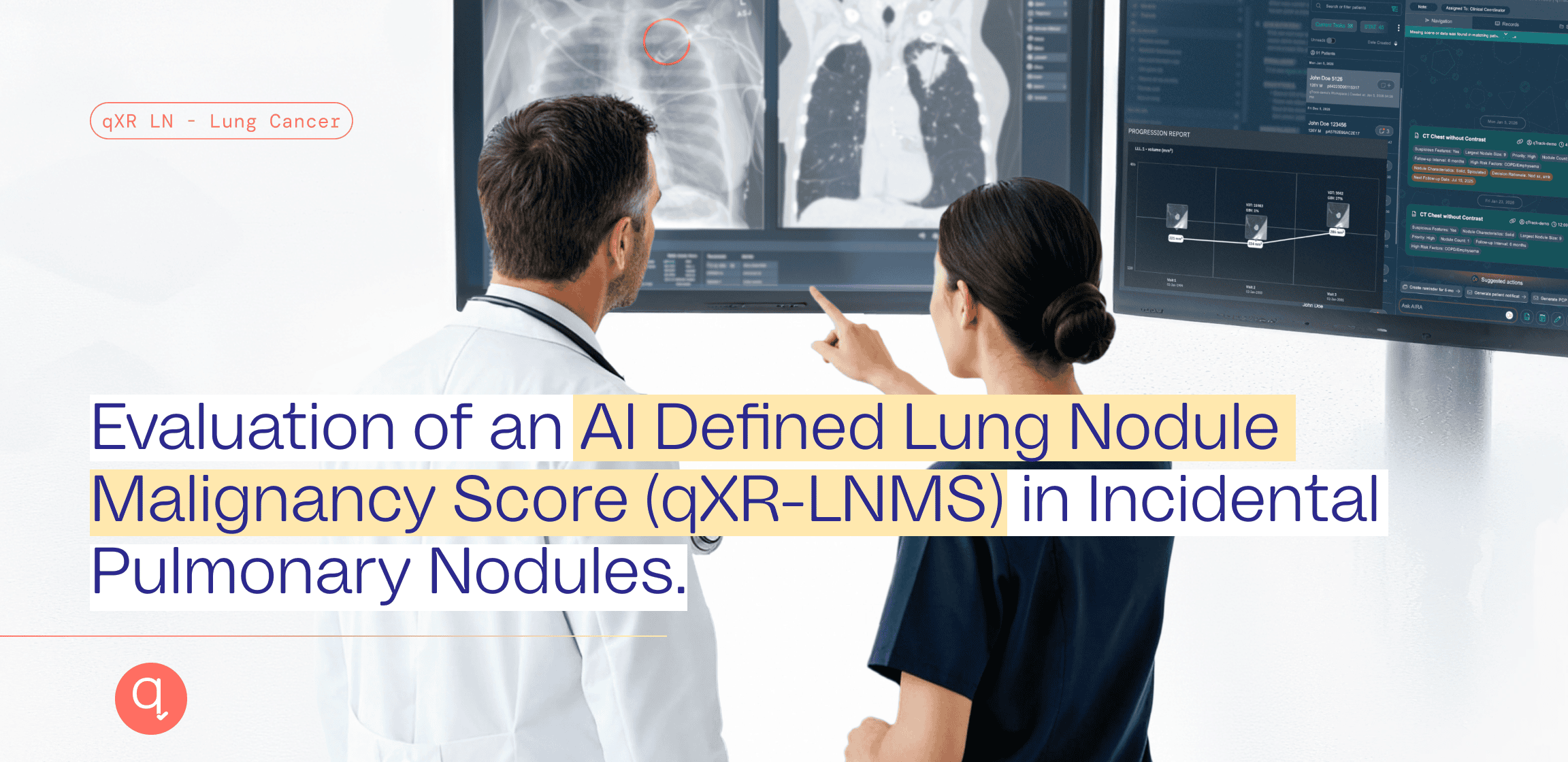
Evaluation of an Artificial Intelligence Defined Lung Nodule Malignancy Score (qXR-LNMS) in Incidental Pulmonary Nodules: The CREATE Study
Author: Deniz Koksal,
Arunkumar Govindarajan,
Hari Kishan Gonuguntla,
Sibel Nayci,
Ricardo Cordova,
Mohamed Helmy Zidan,
Susan McCutcheon,
Ashwini Saha,
Pushpalatha Kantharaju,
Sagar Sen,
Rohitashva Agrawal,
Laksmi Wulandari
Back
To address this gap, Qure.ai developed the qXR-LNMS (Lung Nodule Malignancy Risk), an AI-based tool designed to assess the likelihood of malignancy in lung nodules detected on chest X-rays and support clinical decision-making.
The performance of this tool was evaluated in CREATE study, a prospective, real-world, multi-country observational study conducted across Turkey, Mexico, Egypt, Indonesia, and India. The study included 712 participants aged 35 years and above, each presenting incidental pulmonary nodules (8-30 mm) detected on chest X-rays .
Participants were initially identified using an FDA-cleared AI detection algorithm (qXR-LNMS) and subsequently AI results were reviewed by radiologists. The cohort consisted of both high-risk and low-risk individuals, enabling robust evaluation across patient segments. The primary objective of this study was to assess the predictive performance of qXR-LNMS against radiologist-confirmed LDCT findings, with additional comparison to established tools such as the Mayo Clinic risk model.
The results demonstrated strong predictive performance:
Positive Predictive Value (PPV): 54.2%
Negative Predictive Value (NPV): 93.5%
Importantly, the high NPV indicates a strong ability to rule out malignancy, making it particularly valuable as a triage tool. The AI model also showed 70.6% agreement with the Mayo Clinic risk model, with consistent performance across demographic and clinical subgroups.
Overall, these findings highlight the potential of qXR-LNMS to enable earlier and more accurate risk stratification of lung nodules directly from chest X-rays. By improving confidence in identifying high-risk cases while safely ruling out low-risk nodules, the tool can support more efficient referral pathways and optimize the use of advanced imaging.
In essence, this approach transforms a widely available imaging modality into a more powerful screening and decision-support tool particularly impactful in both resource constrained and high-volume healthcare settings.