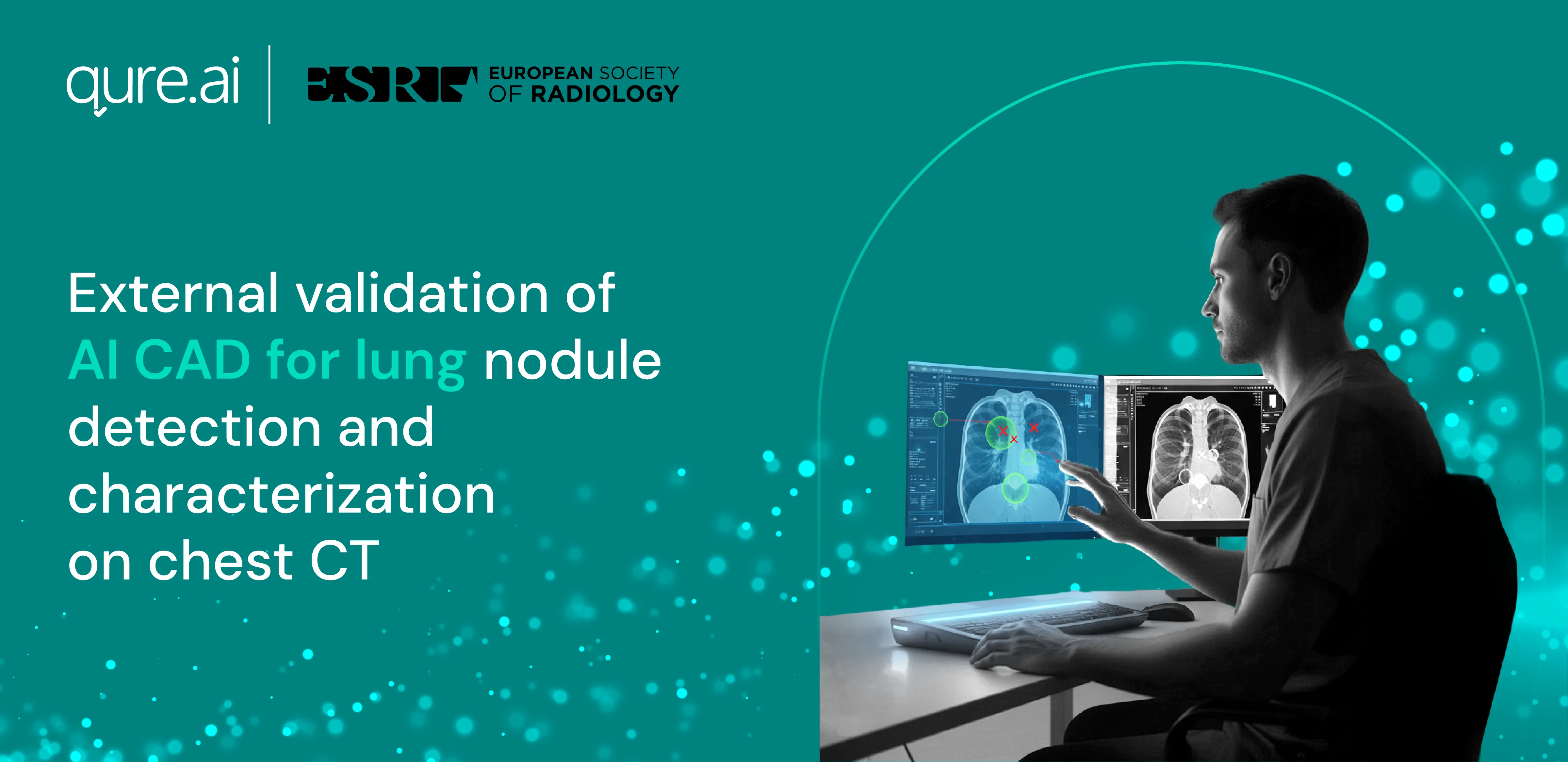
This study externally validated a commercially available Computer-Aided Detection (CAD) system for detecting and characterizing lung nodules (LNs) on 263 chest CT scans from a Dutch university hospital. A total of 183 true nodules were identified in 121 scans, with radiologist 1 (R1) detecting 165/183 (90.2%) and CAD identifying 149/183 (81.4%), including 12 nodules missed by R1. CAD’s false-positive rate was 0.405 per nodule-containing scan. Detection sensitivity varied by nodule type: solid (87.2%), part-solid (89.4%), and ground-glass (59.5%). CAD’s classification accuracy for solid, part-solid, and ground-glass nodules was 98.8%, 38.1%, and 72.0%, respectively, while accuracy for calcification, spiculation, and location was 91.9%, 82.6%, and 94.6%, respectively. Although CAD’s detection rate was slightly lower than a radiologist’s, it successfully identified additional nodules and has the potential to enhance detection. However, texture classification remains an area for improvement, particularly for part-solid and ground-glass nodules.
Published 23 Jul 2024
Validation of a commercially available CAD-system for lung nodule detection and characterization using CT-scans
Author: Jasika Paramasamy,
Souvik Mandal,
Maurits Blomjous,
Ties Mulders,
Daniel Bos,
Joachim G. J. V. Aerts,
Prakash Vanapalli,
Vikash Challa,
Saigopal Sathyamurthy,
Ranjana Devi,
Ritvik Jain &
Jacob J. Visser